Your kidneys work hard every second to filter your blood, remove waste, balance fluids and keep things running. Keeping them healthy is vital and one simple way to achieve this is by drinking enough water. It is easy, yet many people still get it wrong in many ways such as how much they are drinking, what they are drinking and when they are drinking.
Why Water Is So Important for Your Kidneys
Water helps your kidneys filter waste products out of your blood and push them out through urine. It keeps your blood vessels open so blood can reach your kidneys and deliver oxygen and nutrients. It dilutes your urine so that harmful minerals don’t clump together and form kidney stones. And it helps flush out bacteria that can cause urinary tract infections.
When you don’t drink enough, your kidneys have to work harder.
What happens when you don’t drink enough water
When you’re dehydrated the blood supply of the kidney is affected. Your kidneys receive around 20 percent of everything your heart pumps out. When you become dehydrated, your circulating blood volume drops, blood pressure falls, and blood flowing to the kidney reduces. Less blood flow means a drop in the speed at which your kidneys clean your blood. This makes waste products accumulate. Left uncorrected, this can tip into acute kidney injury. A study published in Kidney Research and Clinical Practice, drawing on data from nearly 28,000 adults, found that even mild, everyday dehydration was linked to altered kidney function.
Mild dehydration might leave you feeling tired or foggy. But when you’re consistently under-hydrated, your kidneys produce more concentrated urine, packed with waste products and minerals that can, over time, damage kidney tissue. Research from scientists studying an alarming rise in kidney disease among sugarcane workers and other high intensity agriculture workers in Central America found that severe occupational heat stress and repeated dehydration, causing subclinical kidney injury over years, was likely a major cause of permanent kidney damage. These were otherwise healthy adults. The repeated insult of dehydration was enough.
Dehydration also makes it much easier for kidney stones to form. These stones develop when crystals in your urine stick together, and this is far more likely to happen when your urine is concentrated and there isn’t enough water to keep things moving.
Sip Through the Day. Don’t Try to “Catch Up”
Here’s a common mistake: going all day barely drinking anything, then chugging a large volume of water in the evening to hit some daily target. It doesn’t quite work that way.
Your kidneys process fluids continuously. They’re filtering your blood all day long, every hour, every minute. Drinking water consistently throughout the day is more effective than consuming large amounts all at once. Flooding them in one sitting doesn’t make up for hours of running dry.
A simple approach: keep water nearby at all times. Sip regularly. Don’t wait until you’re very thirsty either. Thirst is a late signal. By the time you feel it, your body is already a step behind.
Water is the best thing you can drink for your kidneys. Not juice. Not sports drinks. Not coffee. And definitely not soda.
Water Versus Other Drinks
Plain water has no sugar, no calories, no chemicals for your kidneys to process. Soft drinks deserve special mention, because a lot of people grab a can and feel like they’ve “hydrated.” They haven’t. Research shows that sugar sweetened beverages are associated with chronic kidney disease. A study found that drinking more than one soda drink per day was linked to an increased risk of developing kidney disease. They often contain phosphoric acid, high sugar loads, and additives that add extra work for your kidneys rather than helping them. Artificially sweetened sodas aren’t a free pass either — the evidence is catching up.
Althoug research suggests a protective effect of water on the kidneys, this doesn’t mean every other drink is off-limits. Herbal teas, diluted unsweetened juices, and water-rich foods like watermelon, cucumbers, and spinach all contribute. But water should be the foundation. If plain water feels boring, try infusing it with citrus, cucumber, or fresh mint — it’s still water, just with a personality.
Drink Lots of Water can be Dangerous Advice For Some People
You’ve probably heard the eight-glasses-a-day rule. But there is no universal rule that applies to everyone. Your actual needs depend on your age, body size, activity level, climate, and health status.
For people living with advanced kidney disease or kidney failure, drinking too much fluid can be actively harmful. When kidneys aren’t filtering properly, excess fluid builds up in the body. The immediate consequence most people think of is high blood pressure. But the greater and more immediate danger for many of these patients is what happens to the lungs.
When fluid accumulates in kidney failure and has nowhere to go, it doesn’t just sit under the skin as swelling. It migrates into the lungs and may cause a life-threatening condition called pulmonary edema which is a common cause of difficulty in breathing and hospital admissions. Pulmonary edema in kidney failure can come on suddenly, causing severe breathlessness, an inability to lie flat, and a terrifying sensation of drowning. It is a medical emergency.
The more advanced the kidney disease, the greater the risk of pulmonary complications. For patients on dialysis, strict fluid limits set by their medical team aren’t optional suggestions. If someone you love is on dialysis, please understand that the “drink more water” reflex you’d apply to anyone else could send them to the emergency room.
If you have any kidney condition or chronic health concern, the question of how much you should drink each day is a conversation for your doctor — not a wellness blog.
Other Things Worth Knowing
- Your kidneys speak salt. Salty foods pull water out of your cells and can leave you dehydrated faster, even if you’re drinking what feels like enough. Sodium rich foods work against your hydration efforts. Cutting back on packaged snacks and fast food has real hydration benefits.
- Alcohol and caffeine aren’t free water. Alcohol suppresses vasopressin, the hormone your kidneys use to hold onto water, so it actively drives fluid loss. Caffeine has a mild diuretic effect too, though your body adapts to it over time. Herbal teas or very light coffee are much more neutral.
- About 20% of your daily hydration comes from food, not drinks. Fruits like watermelon, oranges, and strawberries, and vegetables like cucumber, spinach, and celery are all largely water. This means eating well supports hydration, not just drinking well.
- Older adults are especially vulnerable to dehydration, partly because the sense of thirst diminishes with age. Older kidneys also produce more dilute urine, meaning more water loss, which can lead to urinary tract infections and other complications if fluid intake isn’t kept up deliberately.
- Certain medications increase your fluid needs and the risk of kidney injury when hydration is poor — including some antibiotics (particularly antivirals like acyclovir, which can crystallize in the kidneys when urine is concentrated), diuretics, and as already discussed, NSAIDs. If you’re on any regular medication, it’s worth asking your pharmacist whether hydration is particularly important for that drug.
Practical Tips to Stay Hydrated
- Keep water visible. Out of sight is out of mind. A bottle on your desk, your kitchen counter, or in your bag changes habits without willpower.
- Eat your hydration. Water-rich foods like cucumber, celery, oranges, and watermelon count.
- Adjust for your life. Hot weather, exercise, vomiting, diarrhea, fever, and even centrally heated dry indoor air all increase your fluid needs. Factor those in.
- Watch the sodium. Less salt means less thirst — and less dehydration.
Your Urine as a Window to Hydration Level
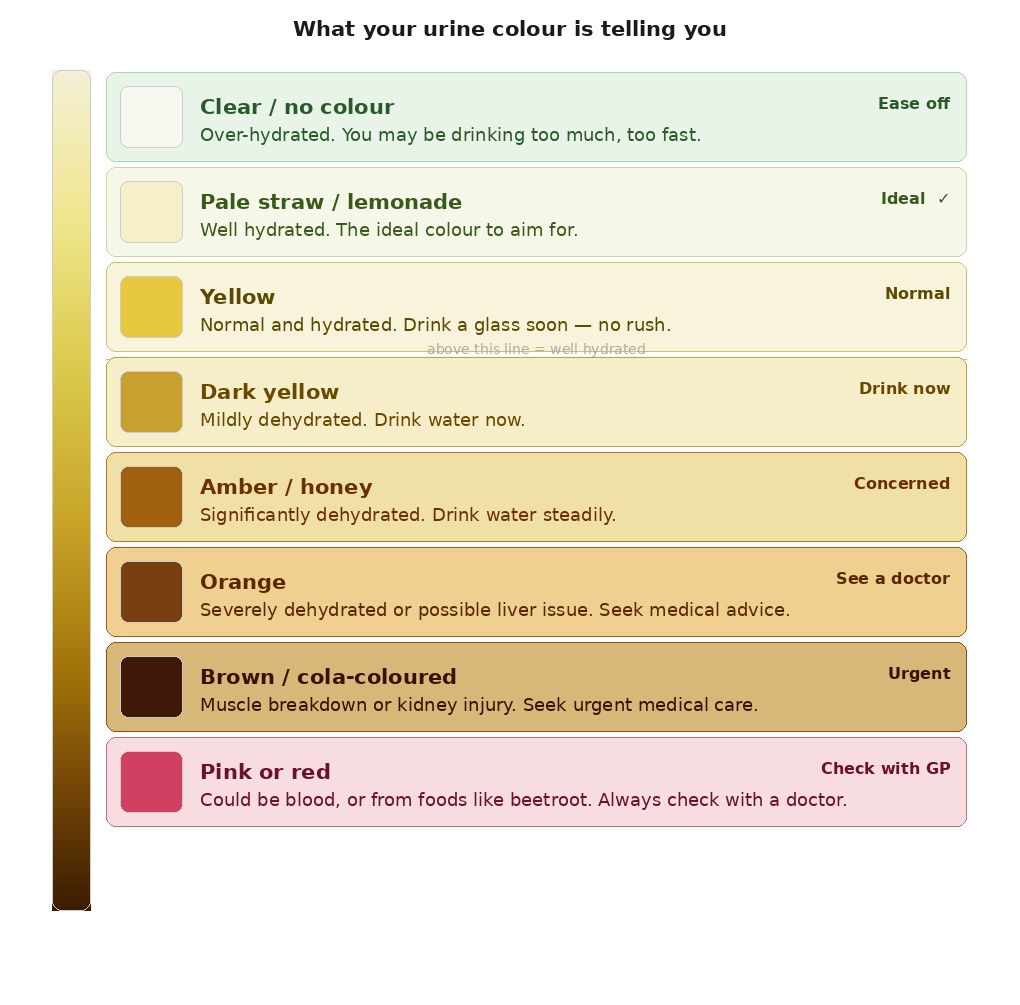
Here’s a simple, free, and surprisingly reliable tool for checking your hydration: look at your urine. The color of your urine is one of the clearest signs of how well-hydrated you are. Pale yellow means you’re doing well. Dark yellow, amber, or anything that looks like apple juice means you need to drink more water, and soon. Clear, colorless urine is generally fine too, though it can occasionally mean you’ve had a bit too much.